Advertisement

Main menu

  • Home
  • Content
    • Current Volume
    • AJEV and Catalyst Archive
    • Best Papers
    • ASEV National Conference Technical Abstracts
    • Back Orders
  • Information For
    • Authors
    • Open Access Publishing
    • AJEV Preprint and AI Software Policy
    • Submission
    • Subscribers
      • Proprietary Rights Notice for AJEV Online
    • Permissions and Reproductions
  • About Us
  • Feedback
  • Alerts
  • Help
  • Login
  • ASEV MEMBER LOGIN

User menu

  • Log in

Search

  • Advanced search
American Journal of Enology and Viticulture
  • Log in
  • Follow ajev on Twitter
  • Follow ajev on Linkedin
American Journal of Enology and Viticulture

Advanced Search

  • Home
  • Content
    • Current Volume
    • AJEV and Catalyst Archive
    • Best Papers
    • ASEV National Conference Technical Abstracts
    • Back Orders
  • Information For
    • Authors
    • Open Access Publishing
    • AJEV Preprint and AI Software Policy
    • Submission
    • Subscribers
    • Permissions and Reproductions
  • About Us
  • Feedback
  • Alerts
  • Help
  • Login
  • ASEV MEMBER LOGIN
Article

Phenolics and Ripening in Grape Berries

Douglas O. Adams
Am J Enol Vitic.  2006  57: 249-256  ; DOI: 10.5344/ajev.2006.57.3.249
Douglas O. Adams
Department of Viticulture and Enology, University of California, Davis, One Shields Ave., Davis, CA 95616.
  • Find this author on Google Scholar
  • Find this author on PubMed
  • Find this author on ADS search
  • Find this author on Agricola
  • Search for this author on this site
  • For correspondence: doadams{at}ucdavis.edu
  • Article
  • Figures & Data
  • Info & Metrics
  • PDF
Loading

Article Figures & Data

Figures

  • Figure 1
    • Download figure
    • Open in new tab
    Figure 1

    A simple diagram of the grape berry used to describe the tissues and phenolic composition in an introductory wine class.

  • Figure 2
    • Download figure
    • Open in new tab
    Figure 2

    This hypothetical condensed tannin is made up of four subunits: catechin, epicatechin, epigallocatechin, epicatechin gallate. The first subunit (catechin) is bound to the second (epicatechin) by an interflavan bond between carbon 4 of catechin and carbon 8 of epicatechin. The first three subunits are referred to as “extension” subunits and only the epicatechin gallate has a free 4 position and is thus referred to as a “terminal” unit.

  • Figure 3
    • Download figure
    • Open in new tab
    Figure 3

    The anthocyanins found in grape berries.

  • Figure 4
    • Download figure
    • Open in new tab
    Figure 4

    The hydroxycinnamates found in grape berries.

  • Figure 5
    • Download figure
    • Open in new tab
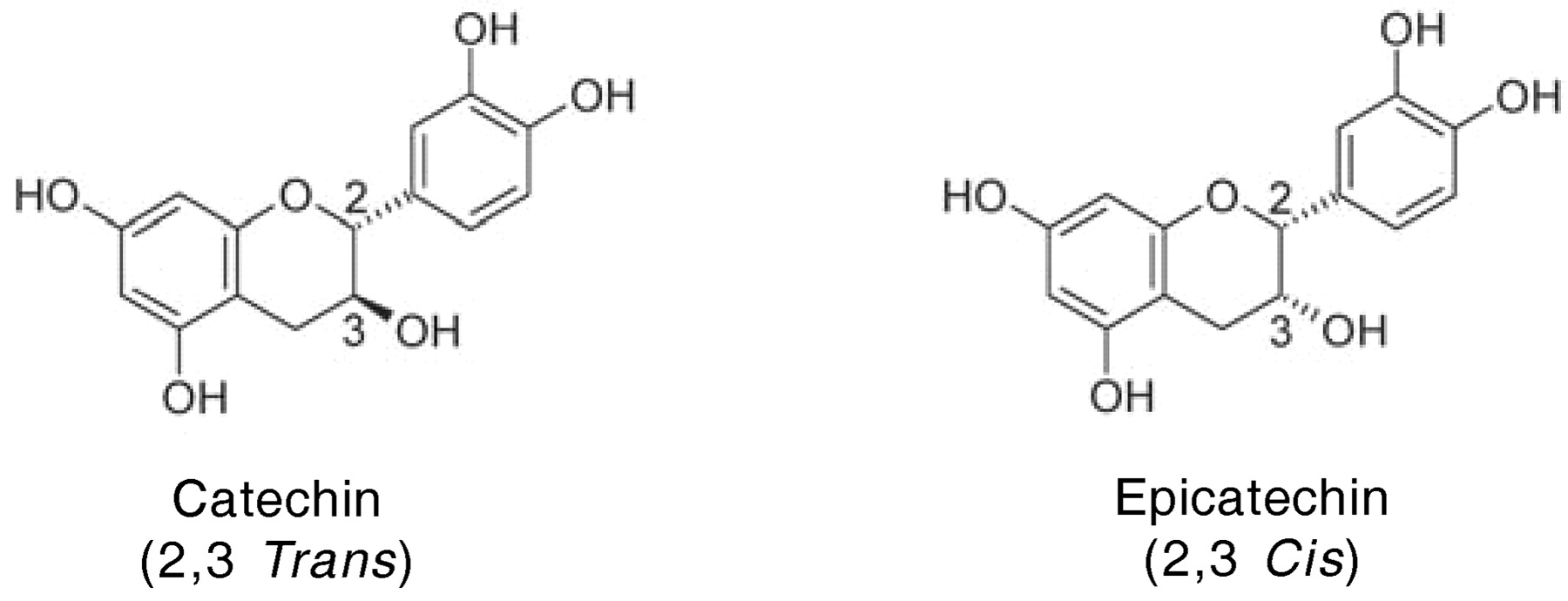
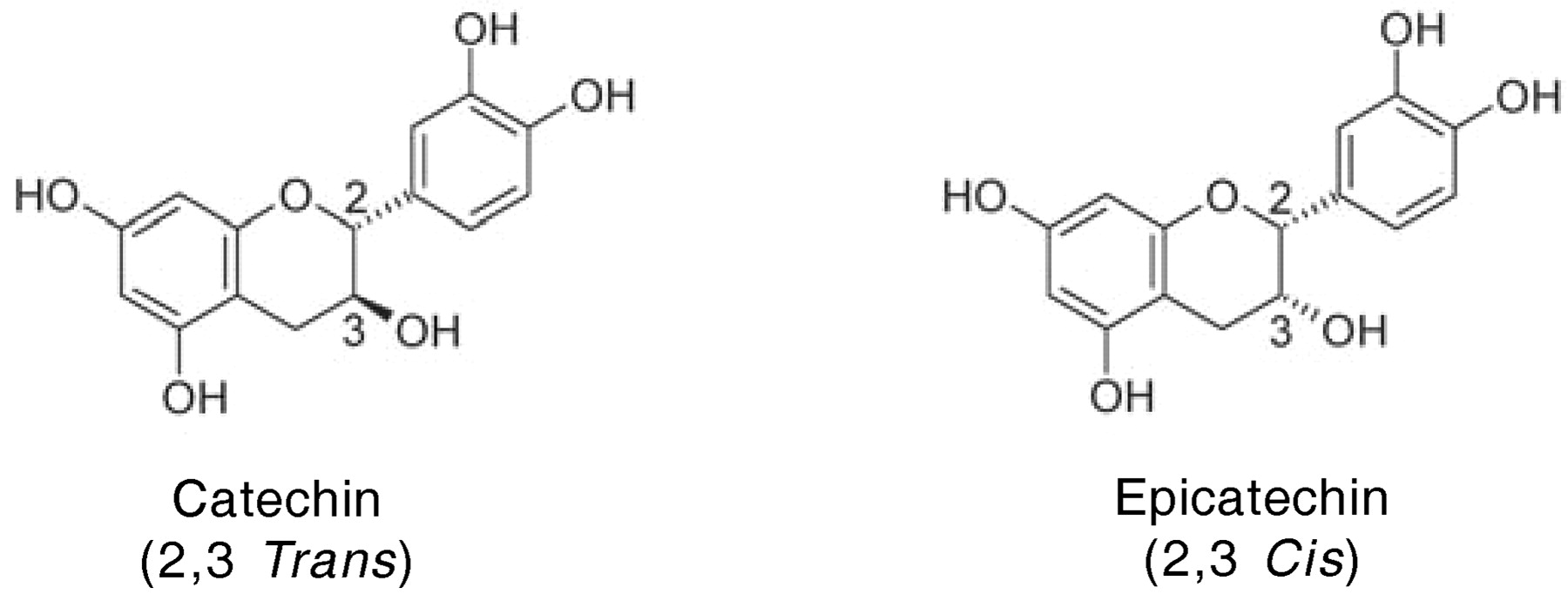
    Figure 5

    Structure of catechin and epicatechin, the most abundant monomeric flavan-3-ols in grape.

  • Figure 6
    • Download figure
    • Open in new tab
    Figure 6

    The flavonols of grape: found in the berry as glucosides, galactosides, and glucuronides where R3 is glucose, galactose, or glucuronic acid, respectively.

  • Figure 7
    • Download figure
    • Open in new tab
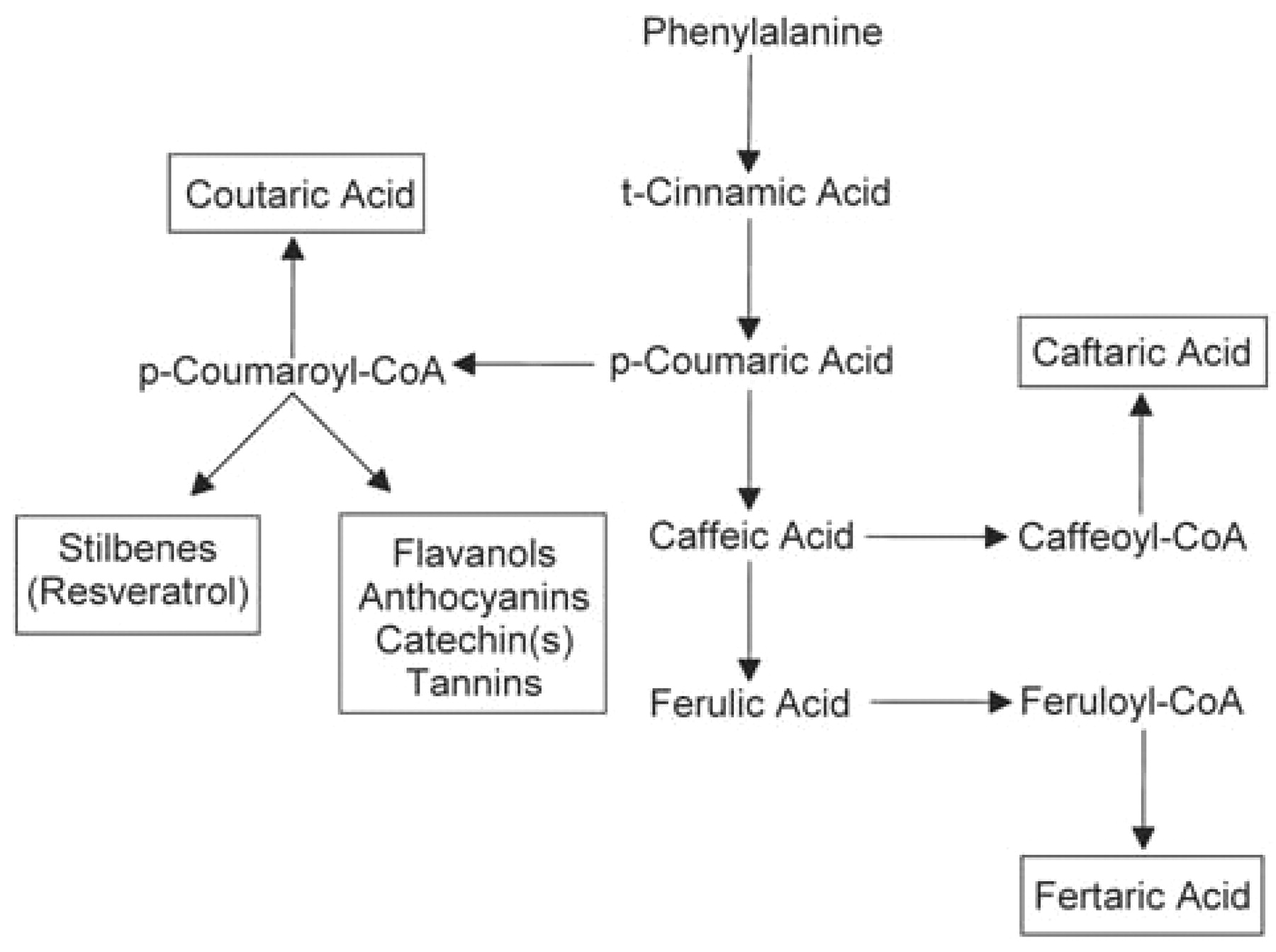
    Figure 7

    The biochemical pathway that leads to the major soluble phenolic classes found in the grape berry. Compounds or classes that accumulate in the fruit are outlined by rectangles and intermediates (not outlined) are usually present at very low levels. Caftaric, coutaric, and fertaric acids are the tartrate esters of the respective cinnamic acid.

  • Figure 8
    • Download figure
    • Open in new tab
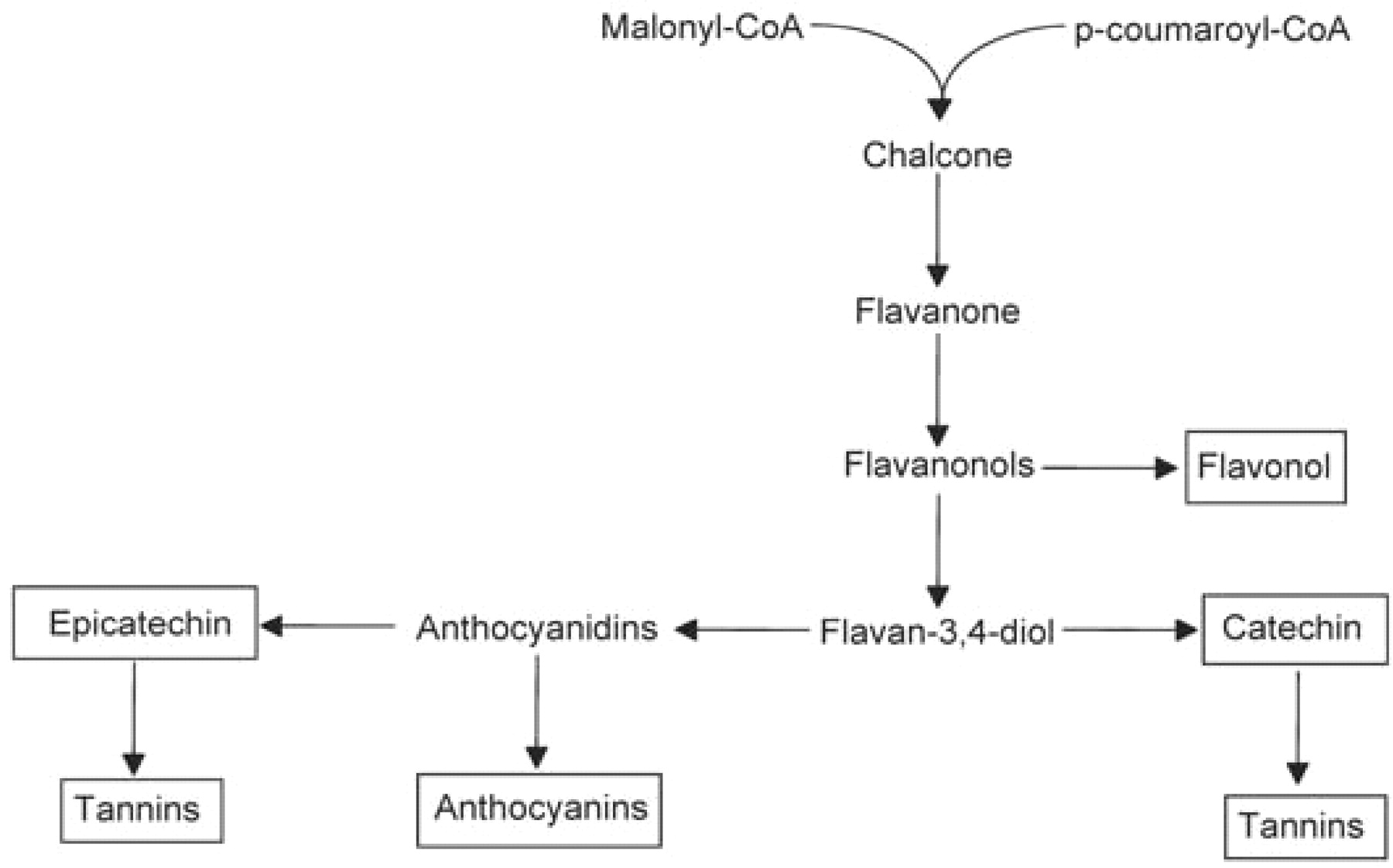
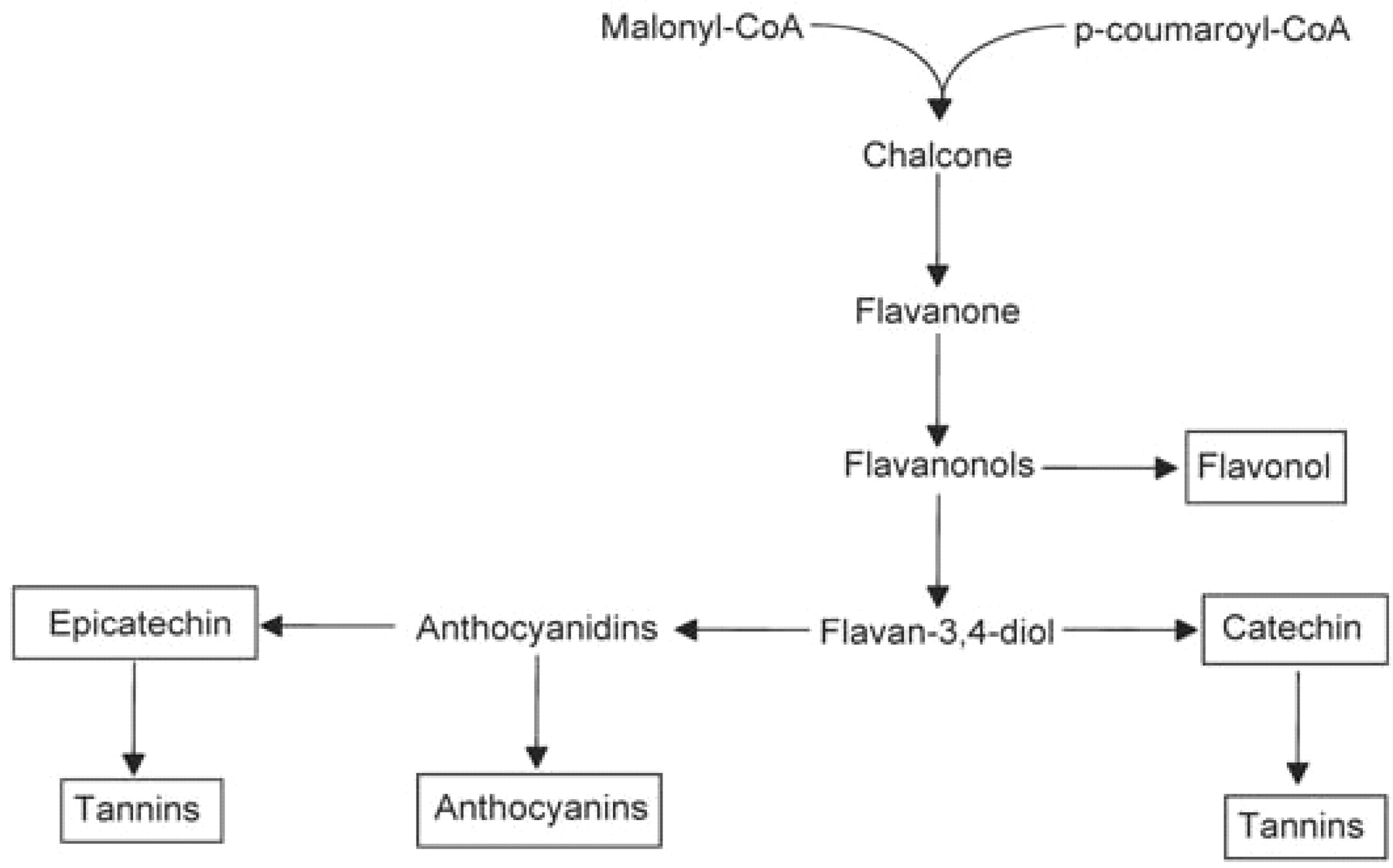
    Figure 8

    The biochemical pathway to the major flavonoids found in grape berries. Compounds that accumulate in the fruit are outlined by rectangles and the intermediates are present at very low levels.

  • Figure 9
    • Download figure
    • Open in new tab
    Figure 9

    Biosynthesis of the flavan-3,4-diol from caffeoyl-CoA and malonyl-CoA. CHS, chalcone synthase; CHI, chalcone isomerase; F3H, flavanone-3-hydroxylase; DFR, dihydroflavonol-4-reductase.

  • Figure 10
    • Download figure
    • Open in new tab
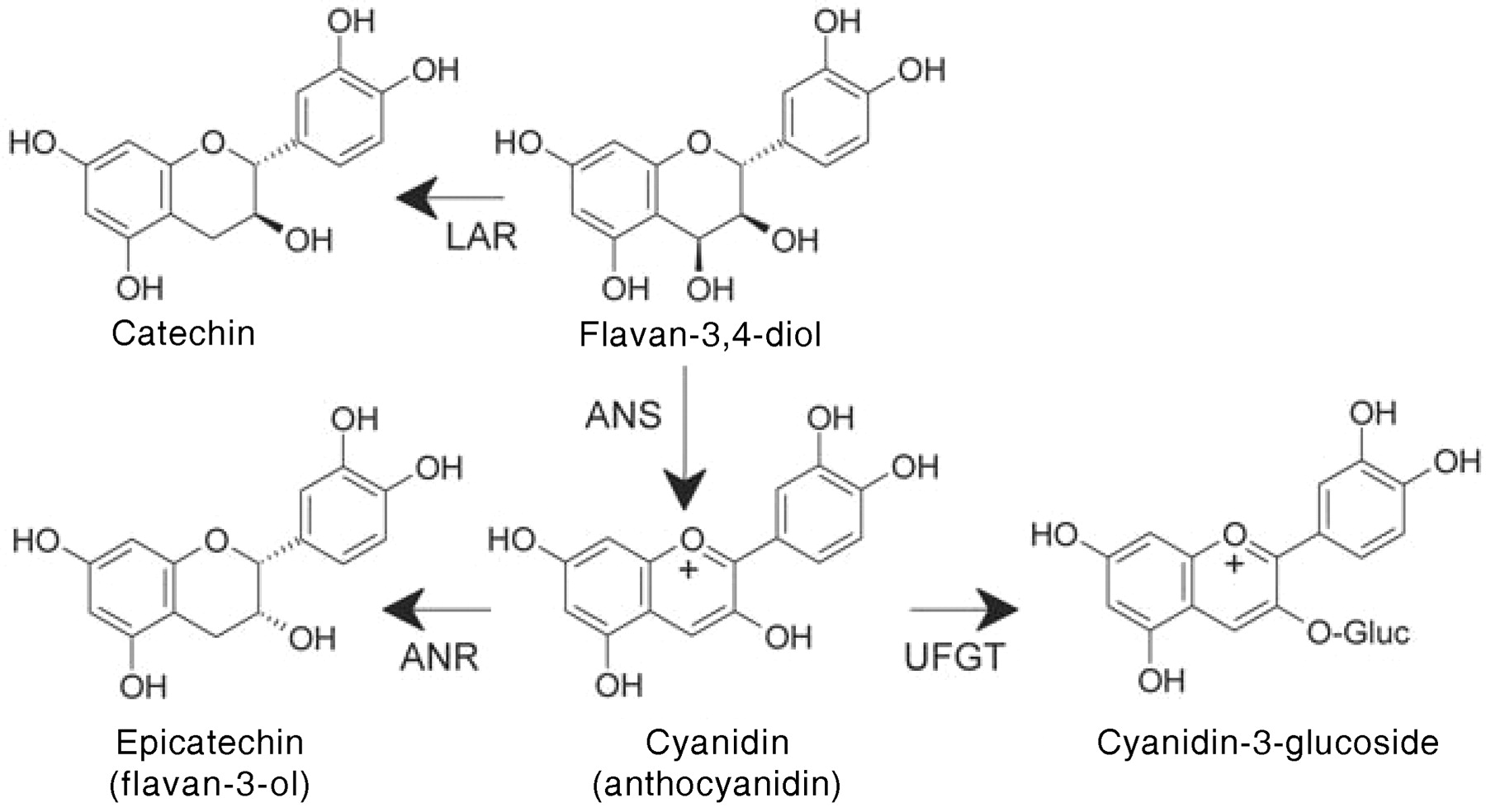
    Figure 10

    Formation of catechin, epicatechin, anthocyanidin (cyanidin), cyanidin-3-glucoside. LAR, leucoanthocyanidin reductase; ANS, anthocyanidin synthase; ANR, anthocyanidin reductase; UFGT, UDP glucose-flavonoid 3-O-glucosyl transferase.

  • Figure 11
    • Download figure
    • Open in new tab
    Figure 11

    Changes in skin and seed tannin in Cabernet Sauvignon berries during ripening. Tannin is expressed in catechin equivalents (CE) on a per berry basis, 1998 and 1999 (Harbertson et al. 2002).

  • Figure 12
    • Download figure
    • Open in new tab
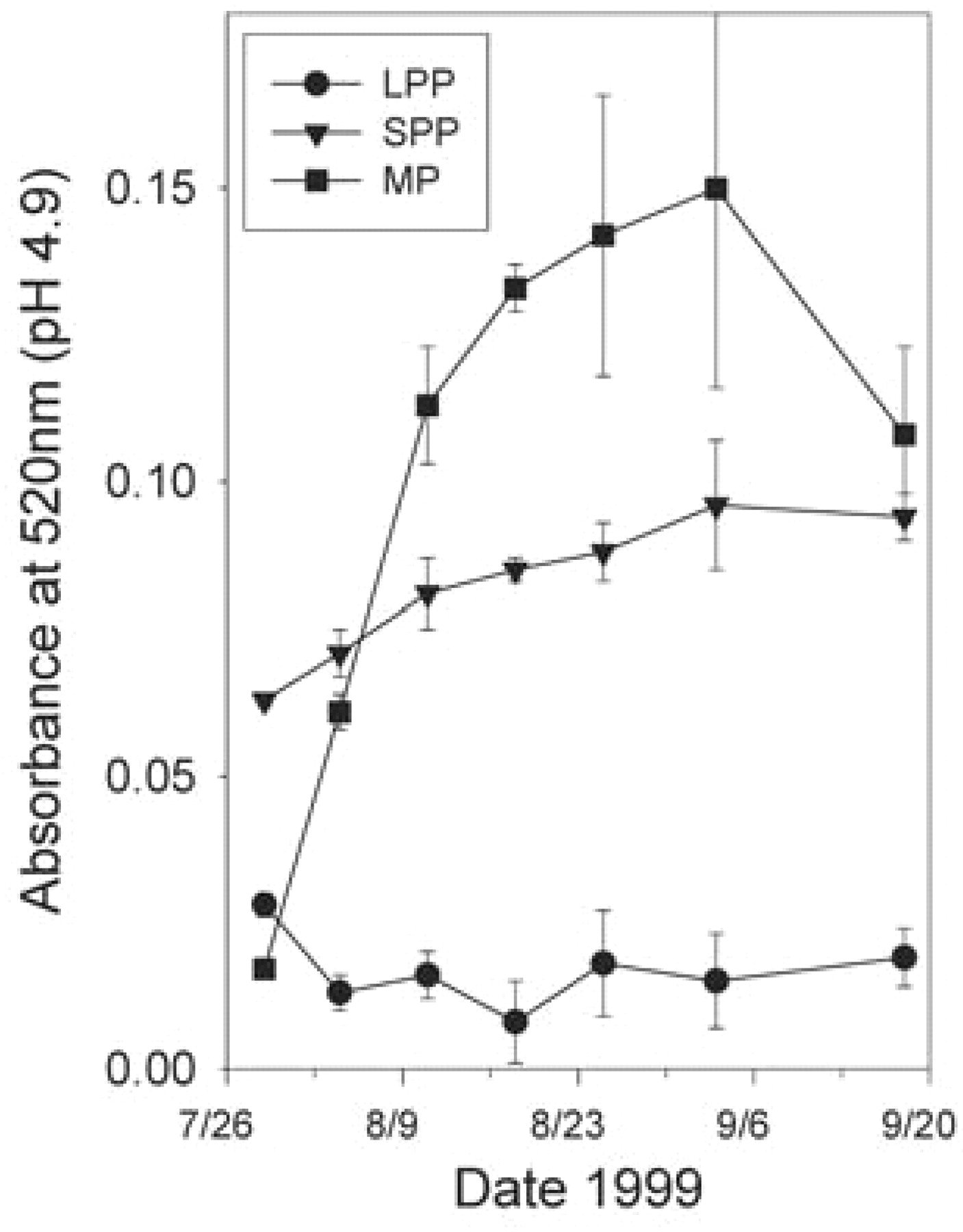
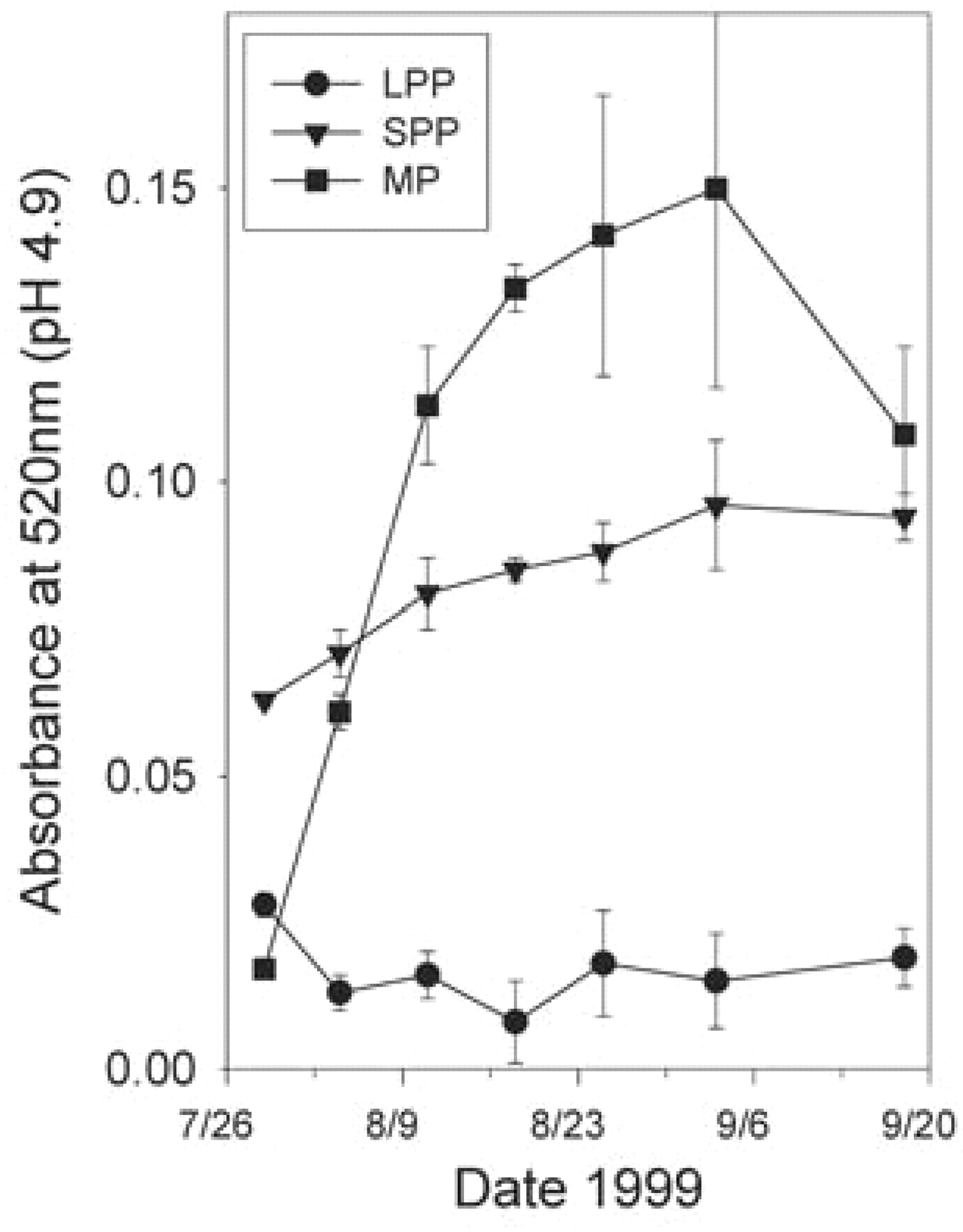
    Figure 12

    Changes in monomeric pigments (MP), large polymeric pigments (LPP), and small polymeric pigments (SPP) in Syrah berries during ripening (Harbertson et al. 2003).

PreviousNext
Back to top

Vol 57 Issue 3
  • Table of Contents
  • Table of Contents (PDF)
  • Index by author
Print
View full PDF
Email Article

Thank you for your interest in spreading the word on AJEV.

NOTE: We only request your email address so that the person you are recommending the page to knows that you wanted them to see it, and that it is not junk mail. We do not capture any email address.

Enter multiple addresses on separate lines or separate them with commas.
Phenolics and Ripening in Grape Berries
(Your Name) has forwarded a page to you from AJEV
(Your Name) thought you would like to read this article from the American Journal of Enology and Viticulture.
CAPTCHA
This question is for testing whether or not you are a human visitor and to prevent automated spam submissions.
Citation Tools
You have accessRestricted access
Phenolics and Ripening in Grape Berries
Douglas O. Adams
Am J Enol Vitic.  2006  57: 249-256  ; DOI: 10.5344/ajev.2006.57.3.249
Douglas O. Adams
Department of Viticulture and Enology, University of California, Davis, One Shields Ave., Davis, CA 95616.
  • Find this author on Google Scholar
  • Find this author on PubMed
  • Search for this author on this site
  • For correspondence: doadams{at}ucdavis.edu

Citation Manager Formats

  • BibTeX
  • Bookends
  • EasyBib
  • EndNote (tagged)
  • EndNote 8 (xml)
  • Medlars
  • Mendeley
  • Papers
  • RefWorks Tagged
  • Ref Manager
  • RIS
  • Zotero

Share
You have accessRestricted access
Phenolics and Ripening in Grape Berries
Douglas O. Adams
Am J Enol Vitic.  2006  57: 249-256  ; DOI: 10.5344/ajev.2006.57.3.249
Douglas O. Adams
Department of Viticulture and Enology, University of California, Davis, One Shields Ave., Davis, CA 95616.
  • Find this author on Google Scholar
  • Find this author on PubMed
  • Search for this author on this site
  • For correspondence: doadams{at}ucdavis.edu
del.icio.us logo Twitter logo Facebook logo Mendeley logo
  • Tweet Widget
  • Facebook Like
  • Google Plus One
Save to my folders

Jump to section

  • Article
    • Abstract
    • Berry Anatomy and Phenolic Composition
    • Phenolic Classes in the Grape Berry
    • Phenolic Biosynthesis in Grape Berry Tissue
    • Anthocyanidins: Intermediates in Tannin Biosynthesis
    • Changes in the Phenolic Composition of Red Grape Berries during Ripening
    • Summary and Conclusions
    • Footnotes
    • Literature Cited
  • Figures & Data
  • Info & Metrics
  • PDF

Related Articles

Cited By...

More from this TOC section

  • Leaf Blade versus Petiole Analysis for Nutritional Diagnosis of Vitis vinifera L. cv. Tempranillo
  • Mechanical Canopy and Crop-Load Management of Pinot gris in a Warm Climate
  • Impact of Exogenous Abscisic Acid on Vine Physiology and Grape Composition of Cabernet Sauvignon
Show more Article

Similar Articles

AJEV Content

  • Current Volume
  • Archive
  • Best Papers
  • ASEV National Conference Technical Abstracts
  • Back Orders

Information For

  • Authors
  • Open Access Publishing
  • AJEV Preprint and AI Software Policy
  • Submission
  • Subscribers
  • Permissions and Reproductions

Other

  • Home
  • About Us
  • Feedback
  • Help
  • Alerts
  • ASEV
asev.org

© 2026 American Society for Enology and Viticulture.  ISSN 0002-9254.

Powered by HighWire