Advertisement

Main menu

  • Home
  • Information For
    • Authors
    • Reviewers
    • Open Access Publishing
    • AJEV Preprint and AI Software Policy
    • Submission
    • Subscribers
      • Proprietary Rights Notice for AJEV Online
    • Permissions and Reproductions
  • Content
    • Current Volume
    • AJEV and Catalyst Archive
    • Best Papers
    • ASEV National Conference Technical Abstracts
    • Back Orders
  • About Us
  • Feedback
  • Alerts
  • Help
  • Login
  • ASEV MEMBER LOGIN

User menu

  • Log in

Search

  • Advanced search
American Journal of Enology and Viticulture
  • Log in
  • Follow ajev on Twitter
  • Follow ajev on Linkedin
American Journal of Enology and Viticulture

Advanced Search

  • Home
  • Information For
    • Authors
    • Reviewers
    • Open Access Publishing
    • AJEV Preprint and AI Software Policy
    • Submission
    • Subscribers
    • Permissions and Reproductions
  • Content
    • Current Volume
    • AJEV and Catalyst Archive
    • Best Papers
    • ASEV National Conference Technical Abstracts
    • Back Orders
  • About Us
  • Feedback
  • Alerts
  • Help
  • Login
  • ASEV MEMBER LOGIN
Research Article

Evaluation of the Concord Crop Load Response for Current Commercial Production in New York

Terry Bates, Rhiann Jakubowski, James A. Taylor
Am J Enol Vitic.  2021  72: 1-11  ; DOI: 10.5344/ajev.2020.20026
Terry Bates
1Cornell University, School of Integrative Plant Science, Horticulture Section, Cornell Lake Erie Research and Extension Laboratory, Portland, NY;
3Current address: Cornell Lake Erie Research and Extension Laboratory, 6592 West Main Road, Portland, New York, 14769.
  • Find this author on Google Scholar
  • Find this author on PubMed
  • Find this author on ADS search
  • Find this author on Agricola
  • Search for this author on this site
  • For correspondence: trb7{at}cornell.edu
Rhiann Jakubowski
1Cornell University, School of Integrative Plant Science, Horticulture Section, Cornell Lake Erie Research and Extension Laboratory, Portland, NY;
  • Find this author on Google Scholar
  • Find this author on PubMed
  • Find this author on ADS search
  • Find this author on Agricola
  • Search for this author on this site
James A. Taylor
2ITAP, University of Montpellier, INRAE, Institut Agro, Montpellier, France;
  • Find this author on Google Scholar
  • Find this author on PubMed
  • Find this author on ADS search
  • Find this author on Agricola
  • Search for this author on this site
  • Article
  • Figures & Data
  • Info & Metrics
  • PDF
Loading

Article Figures & Data

Figures

  • Tables
  • Figure 1
    • Download figure
    • Open in new tab
    Figure 1

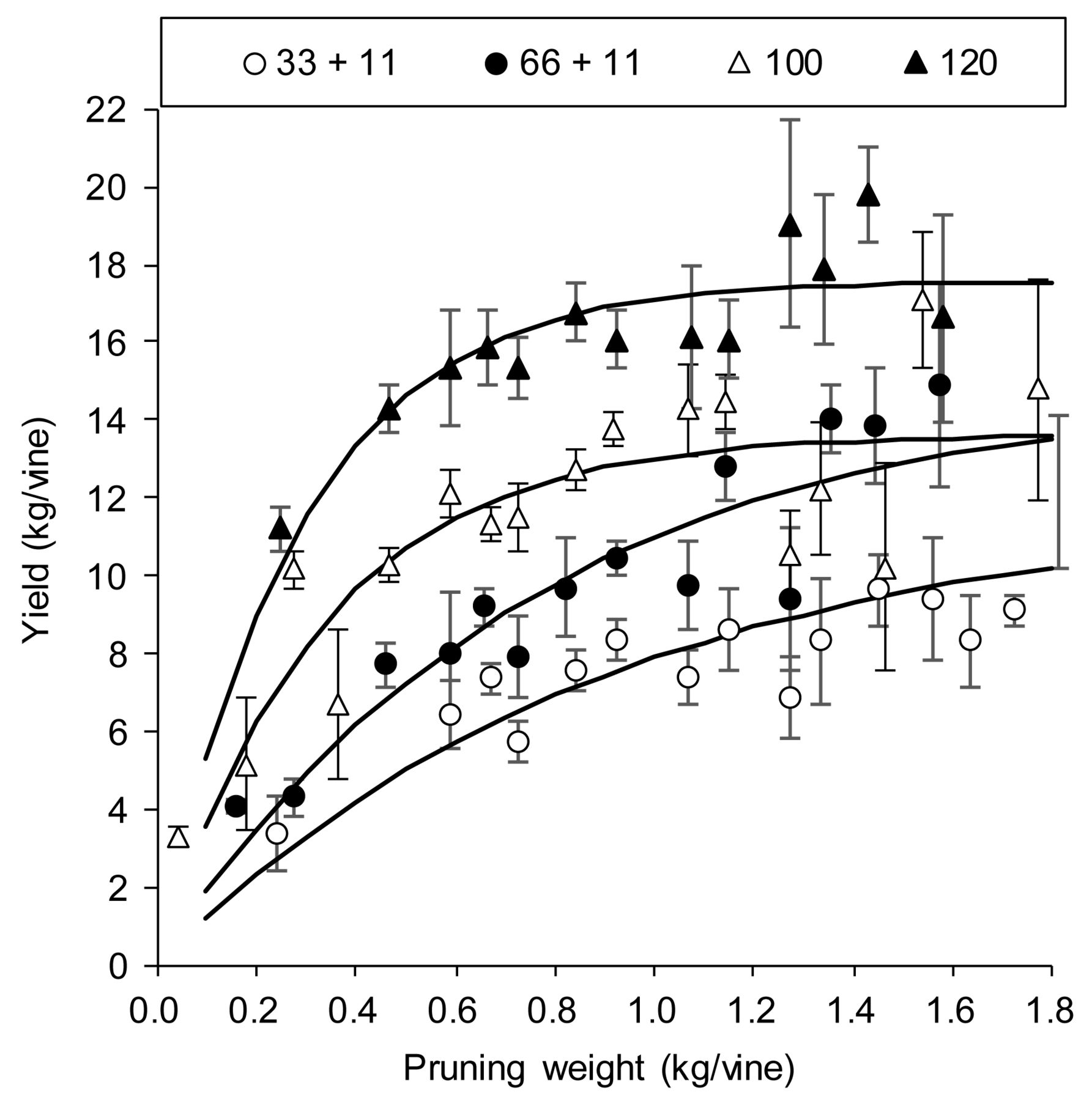
    The effect of Concord pruning weight (PW) on fresh fruit yield at two variable node and two fixed node pruning severities. Vines were balanced pruned to retain 33 (open circles) or 66 (closed circles) nodes for the first 500 g pruning weight plus an additional 11 nodes for each additional 500 g or pruned to retain 100 (open triangles) or 120 (closed triangles) nodes per vine, regardless of pruning weight. Individual vine observations (n = 36 per year) from 2001 to 2004 were combined by pruning treatment and binned by 0.1 kg pruning weight (bars = ±SE). Fitted curves for 33 + 11: Yield = 11.8 - ([11.8] * EXP[-1.1 * PW]), R2 = 0.91; 66 + 11: Yield = 14.9 - ([14.9] * EXP[-1.3 * PW]), R2 = 0.94; 100 nodes: Yield = 13.6 - ([13.6] * EXP[-3.1 * PW]), R2 = 0.87; 120 nodes: Yield = 17.6 - ([17.6] * EXP[-3.6 * PW]), R2 = 0.88.

  • Figure 2
    • Download figure
    • Open in new tab
    Figure 2

    The effect of Concord yield:pruning weight (Y:PW) on harvest juice soluble solids from 2001 to 2004. Vines were grouped by pruning severity (33 + 11, 66 + 11, or 100 nodes: open symbols) or by 120-node pruning with midseason fruit-thinning (closed symbols). There were 108 pruning observations per year (36 per pruning level) and 75 thinning observations per year. Data was binned by crop load in intervals of 2 Y:PW (bars = ±SE).

  • Figure 3
    • Download figure
    • Open in new tab
    Figure 3

    The effect of Concord yield:pruning weight (Y:PW) on the seasonal change in pruning weight from 2001 to 2004. Vines were grouped by pruning severity (33 + 11, 66 + 11, or 100 nodes: open symbols) or by 120-node pruning with midseason fruit-thinning (closed symbols). There were 108 pruning observations per year (36 per pruning level) and 75 thinning observations per year. Data was binned by crop load in intervals of 2 Y:PW (bars = ±SE).

  • Figure 4
    • Download figure
    • Open in new tab
    Figure 4

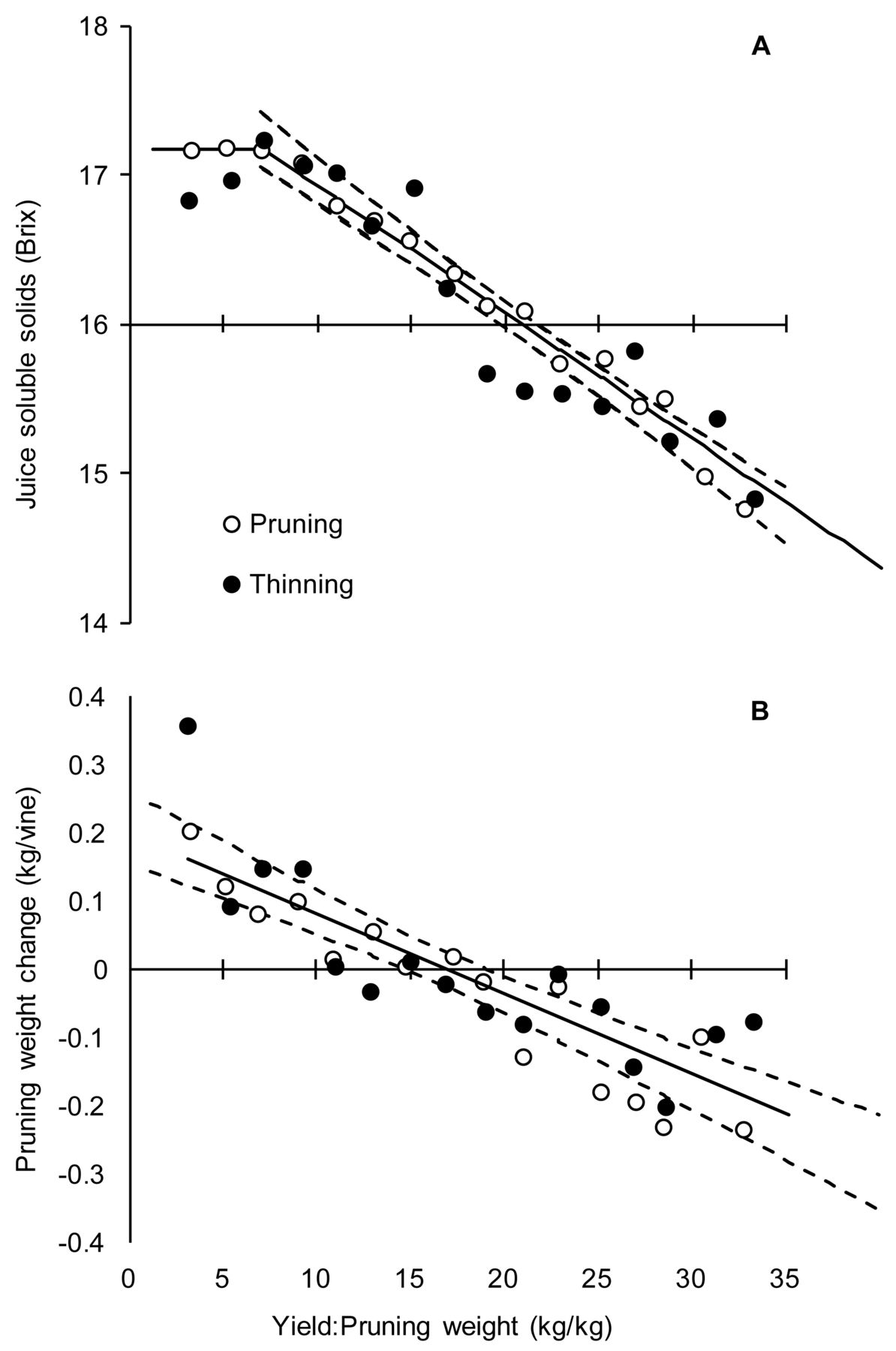
    The general four-year Concord crop load response on harvest juice soluble solids (A) and seasonal change in vine pruning weight (B). Pruning severity (open circles) or midseason fruit-thinning (closed circles) was used to generate a range of yield:pruning weight. Each point is the mean of four years (n = 4). Pruning and thinning data were combined for the mean response. A broken-stick model was fitted to illustrate the inflection point on the juice soluble solids response (see Equation 1). For the pruning weight response, a linear model was used (see Equation 2). Dashed lines indicate 95% mean confidence limits.

  • Figure 5
    • Download figure
    • Open in new tab
    Figure 5

    The effect of Concord yield:pruning weight on harvest juice soluble solids (A) and the seasonal change in vine pruning weight (B) from 1999 to 2009. Dashed lines are individual year trend lines and the solid lines are the mean response for all years. (n = 75 for 1999 to 2004, 2006, and 2010; 18 for 2005; and 42 for 2007 to 2009). The solid lines are the mean response (n = 11 years).

  • Figure 6
    • Download figure
    • Open in new tab
    Figure 6

    The effect of growing degree day (base 10°C) and precipitation (mm) accumulation on the yield:pruning weight (Y:PW) needed to achieve 16 Brix at harvest (A and B) or no seasonal pruning weight change (C and D) in New York Concord from 1999 to 2009. Data labels indicate year.

  • Figure 7
    • Download figure
    • Open in new tab
    Figure 7

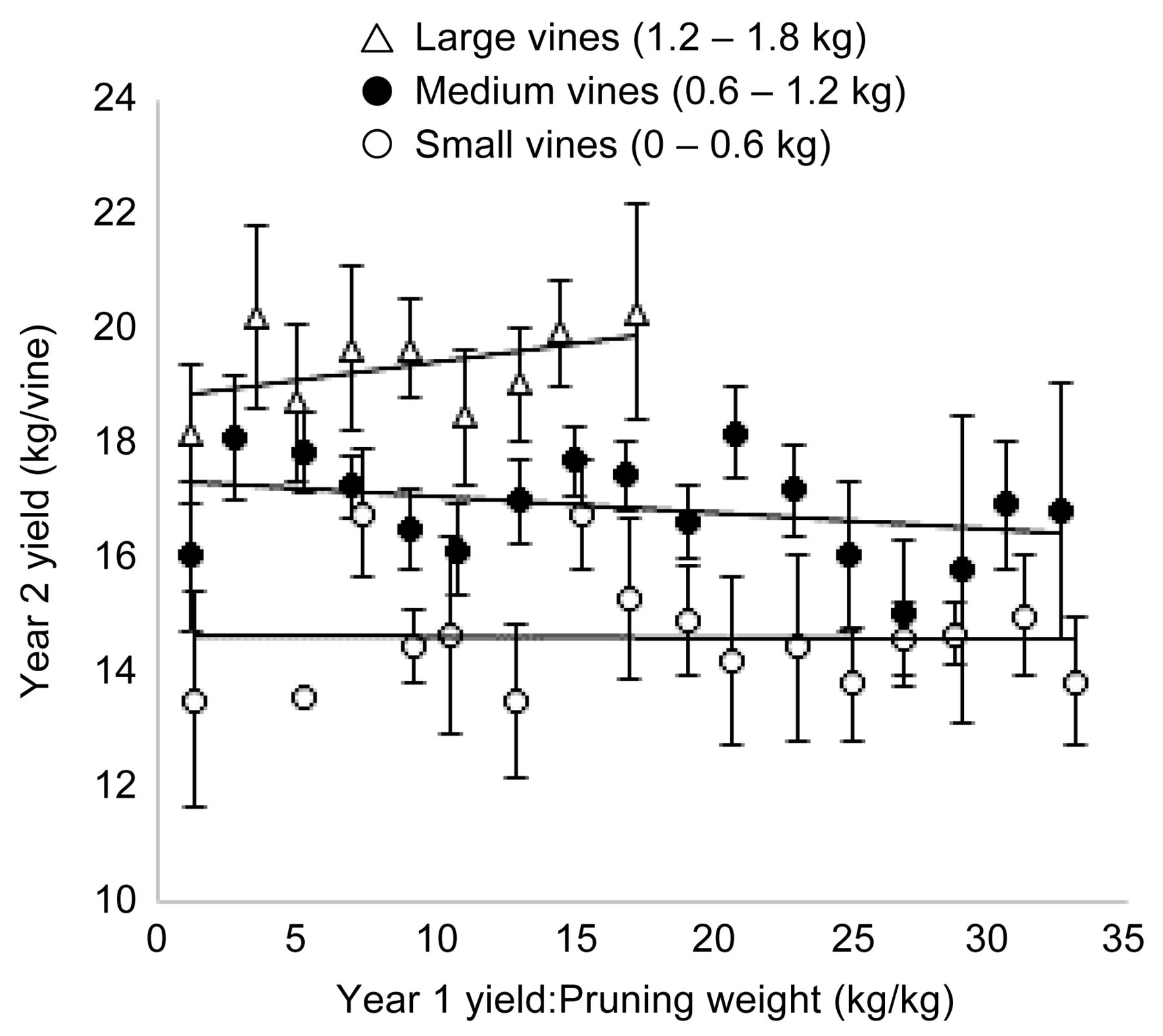
    The relationship of year 1 yield:pruning weight (Y:PW) on year 2 yield on small (0 to 0.6 kg), medium (0.6 to 1.2 kg), and large (1.2 to 1.8 kg) vine size classes in Concord grapevines. Data was pooled from an 11-year fruit-thinning study, grouped by vine size class, and binned in intervals of Y:PW = 2 (each point n = 10, bars = ±SE).

Tables

  • Figures
  • Table 1

    Weather and phenology from Cornell’s Taschenberg Vineyard Laboratory, Fredonia, NY, from 1999 to 2009. GDD, growing degree day.

    Table 1
  • Table 2

    Multivariate analysis of yield:pruning weight (Y:PW) and treatment (pruning or thinning) on harvest juice soluble solids or the seasonal change in pruning weight in New York Concord from 2001 to 2004. Model used standard least squares and effect tests (Prob > F) are shown.

    Table 2
  • Table 3

    Multivariate regression effect tests of seasonal growing degree days or precipitation on the yield:pruning weight (Y:PW) needed to reach harvest juice soluble solids of 16 Brix or no seasonal change in vine pruning weight in New York-grown Concord from 1999 to 2009. GDD, growing degree days.

    Table 3
  • Table 4

    General crop load descriptions and management recommendations for Concord production in the Lake Erie AVA.

    Table 4
PreviousNext
Back to top

Vol 72 Issue 1

Issue Cover
  • Table of Contents
  • Table of Contents (PDF)
  • About the Cover
  • Index by author
Print
View full PDF
Email Article

Thank you for your interest in spreading the word on AJEV.

NOTE: We only request your email address so that the person you are recommending the page to knows that you wanted them to see it, and that it is not junk mail. We do not capture any email address.

Enter multiple addresses on separate lines or separate them with commas.
Evaluation of the Concord Crop Load Response for Current Commercial Production in New York
(Your Name) has forwarded a page to you from AJEV
(Your Name) thought you would like to read this article from the American Journal of Enology and Viticulture.
CAPTCHA
This question is for testing whether or not you are a human visitor and to prevent automated spam submissions.
Citation Tools
Open Access
Evaluation of the Concord Crop Load Response for Current Commercial Production in New York
Terry Bates, Rhiann Jakubowski, James A. Taylor
Am J Enol Vitic.  2021  72: 1-11  ; DOI: 10.5344/ajev.2020.20026
Terry Bates
1Cornell University, School of Integrative Plant Science, Horticulture Section, Cornell Lake Erie Research and Extension Laboratory, Portland, NY;
3Current address: Cornell Lake Erie Research and Extension Laboratory, 6592 West Main Road, Portland, New York, 14769.
  • Find this author on Google Scholar
  • Find this author on PubMed
  • Search for this author on this site
  • For correspondence: trb7{at}cornell.edu
Rhiann Jakubowski
1Cornell University, School of Integrative Plant Science, Horticulture Section, Cornell Lake Erie Research and Extension Laboratory, Portland, NY;
  • Find this author on Google Scholar
  • Find this author on PubMed
  • Search for this author on this site
James A. Taylor
2ITAP, University of Montpellier, INRAE, Institut Agro, Montpellier, France;
  • Find this author on Google Scholar
  • Find this author on PubMed
  • Search for this author on this site

Citation Manager Formats

  • BibTeX
  • Bookends
  • EasyBib
  • EndNote (tagged)
  • EndNote 8 (xml)
  • Medlars
  • Mendeley
  • Papers
  • RefWorks Tagged
  • Ref Manager
  • RIS
  • Zotero

Share
Open Access
Evaluation of the Concord Crop Load Response for Current Commercial Production in New York
Terry Bates, Rhiann Jakubowski, James A. Taylor
Am J Enol Vitic.  2021  72: 1-11  ; DOI: 10.5344/ajev.2020.20026
Terry Bates
1Cornell University, School of Integrative Plant Science, Horticulture Section, Cornell Lake Erie Research and Extension Laboratory, Portland, NY;
3Current address: Cornell Lake Erie Research and Extension Laboratory, 6592 West Main Road, Portland, New York, 14769.
  • Find this author on Google Scholar
  • Find this author on PubMed
  • Search for this author on this site
  • For correspondence: trb7{at}cornell.edu
Rhiann Jakubowski
1Cornell University, School of Integrative Plant Science, Horticulture Section, Cornell Lake Erie Research and Extension Laboratory, Portland, NY;
  • Find this author on Google Scholar
  • Find this author on PubMed
  • Search for this author on this site
James A. Taylor
2ITAP, University of Montpellier, INRAE, Institut Agro, Montpellier, France;
  • Find this author on Google Scholar
  • Find this author on PubMed
  • Search for this author on this site
del.icio.us logo Twitter logo Facebook logo Mendeley logo
  • Tweet Widget
  • Facebook Like
  • Google Plus One
Save to my folders

Jump to section

  • Article
    • Abstract
    • Materials and Methods
    • Results
    • Discussion
    • Conclusions
    • Acknowledgments:
    • Footnotes
    • Literature Cited
  • Figures & Data
  • Info & Metrics
  • PDF

Related Articles

Cited By...

More from this TOC section

  • Diversity of Wild Yeasts During Spontaneous Fermentation of Wines from Local Grape Varieties in Turkey
  • Bioprotective Effect of Pichia kluyveri and Lactiplantibacillus plantarum in Winemaking Conditions
  • Vine Age Affects Vine Performance, Grape and Wine Chemical and Sensory Composition of cv. Zinfandel from California
Show more Research Article

Similar Articles

AJEV Content

  • Current Volume
  • Archive
  • Best Papers
  • ASEV National Conference Technical Abstracts
  • Back Orders

Information For

  • Authors
  • Open Access Publishing
  • AJEV Preprint and AI Software Policy
  • Submission
  • Subscribers
  • Permissions and Reproductions

Other

  • Home
  • About Us
  • Feedback
  • Help
  • Alerts
  • ASEV
asev.org

© 2026 American Society for Enology and Viticulture.  ISSN 0002-9254.

Powered by HighWire